Solitaire TriPeaks Journey
- 4.7
- Rating
- 10.00M
- Installs
- Free
- Price

 Analysis by App-foxy
I spent time with Solitaire TriPeaks Journey as a casual card game, and my first impression was clear: it is built for people who enjoy familiar solitaire rules but want a little more structure than simply opening a deck and playing isolated hands. The central idea is a journey through TriPeaks-style challenges, with companions giving the experience a more guided, game-like feeling. It remains easy to understand, yet the changing board layouts make each round feel more purposeful than a completely traditional solitaire session.
That balance is the reason I can imagine recommending it to a friend who wants something relaxing for short breaks. You can play without learning a complicated ruleset, but you still have to make decisions about which exposed card to remove next and when to protect a useful sequence. It is not a deep strategy game in the same way as a competitive collectible card title, and it does not try to be. Its appeal comes from quick decisions, gentle progression, and the satisfaction of clearing a layout.
How the current game feels in everyday use
I find the everyday rhythm works best when I treat each hand as a small puzzle, not a race to clear the screen. A quick scan of the exposed cards before moving helps me spot whether a tempting run might hide a better opening elsewhere. That simple pause makes short sessions feel more deliberate and gives the journey structure room to support the cards rather than compete with them.
You May Also Like

 Blood Strike: 2.5 Anniversary
Blood Strike’s Loadouts Turn Every Drop Into a Tactical Gamble
A close look at Blood Strike’s custom loadouts: how fast access to signature weapons reshapes its battle royale rhythm, rewards preparation, and narrows the gap between fights.

 Pandora - Music & Podcasts
Pandora’s Music Is Easy to Start, but Harder to Recover
Pandora’s strength is its low-effort path from a seed to a station. Its weak spot is how much confidence it asks you to place in connection, setup, and quiet recovery.

 8 Ball Pool
 Is Built on Rivalries, Rematches, and Routine
A close look at the rivalries, rematches, shared routines, and unanswered safety questions that turn a quick pool match into a persistent mobile community.

 Samsung Music
’s Quiet Strength Is Playing What You Already Own
Its reach comes less from spectacle than from dependable access to a personal library. That simplicity is both the app’s strongest retention engine and its ceiling.

 AccuWeather: Weather Radar
AccuWeather Review: A Quick, Clear Forecast for Everyday Decisions
For everyday plans, the best forecast is the one you can understand quickly. AccuWeather makes rain timing, radar, and local conditions easy to act on, with a few trade-offs.

 Hill Climb Racing
Why Hill Climb Racing Still Turns Crashes Into One More Run
A tiny car, a bumpy hill and one more upgrade: Hill Climb Racing keeps resurfacing because its simple chaos makes every near-miss feel personal.
More From Our News Desk
View All News


A familiar card format with a journey around it
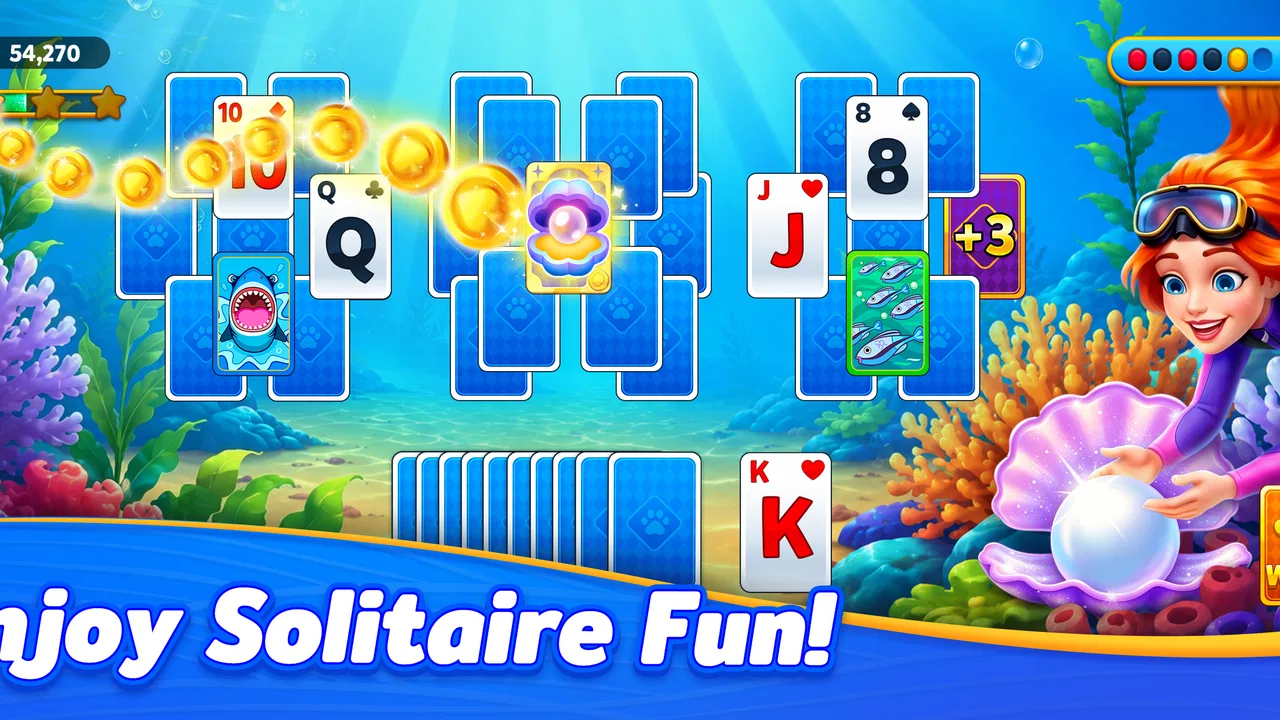
TriPeaks solitaire is easy to pick up because the basic rhythm is intuitive. Cards are arranged in several peaks, and I remove cards that sit one rank above or below the current card. When the board offers a run of connected moves, the round develops a pleasant momentum: one successful choice opens another card, which may reveal a further option. When that chain stops, I draw from the stock and reassess the layout.
The journey framing gives those individual hands a stronger sense of context. Instead of treating every deal as a disposable puzzle, I feel as though I am moving through a sequence of challenges alongside the game’s companions. That makes the title more approachable for someone who might find a plain solitaire app too bare, while still keeping the focus on cards rather than turning the experience into a different genre.
In my experience, the best sessions are short. A round works well while waiting for an appointment, taking a break from work, or winding down before bed. I do not need to reserve a long uninterrupted period, and the rules are simple enough that I can return after a few days without relearning the game. That convenience is a real strength, especially for players who want a low-pressure pastime rather than a game demanding constant attention.
Where the decisions actually matter
The game looks simple, but careless choices can end a promising run. One useful habit is to scan the covered cards before committing to the first available move. Removing a card immediately is not always best if another move can uncover a larger section of the layout or preserve a longer sequence. I found that thinking one or two moves ahead makes the experience more satisfying without making it exhausting.
Another practical technique is to treat the stock as a limited resource rather than a button to press whenever the current move disappears. If several cards are available, I compare which choice opens the most useful area and which choice leaves a better follow-up. This is particularly helpful when two legal moves appear equally attractive. The stronger option is often the one that exposes a card while keeping the current run alive.
That small layer of planning is one of the less obvious reasons the game holds my attention. A generic solitaire app can become automatic after a while, but TriPeaks layouts ask me to read the board. Luck still influences the outcome, so careful play cannot guarantee success, yet good sequencing gives the player a meaningful role in the result.
A realistic use case for casual players
Imagine having ten minutes before a train arrives. A competitive online card game may be inconvenient because it expects a complete match, while a large role-playing game may take too long to load into a meaningful activity. This title fits that gap well. I can start a hand, make a few decisions, and either finish or leave without feeling that I have abandoned a team or damaged a long session.
The same quality helps during a quiet evening when I want something more engaging than scrolling but less demanding than a puzzle game with complicated rules. The journey presentation gives me a reason to continue, while the solitaire format keeps the mental workload modest. For older family members or anyone new to mobile games, that combination may be more inviting than an app filled with unfamiliar systems.
It is also suitable for players who like repetition with small variations. The core action does not change dramatically, so anyone seeking constant novelty may find it restrained. For me, that consistency is useful when I want a dependable distraction, but it is also the main reason I would not present it as an all-purpose game for every type of player.
What the version and long-term support suggest
When I think about a game’s version and continued presence, I look for practical signs of a stable experience rather than assuming every update changes how it plays. Here, the current release and established history make it reasonable to approach it as a familiar TriPeaks game to return to, while still judging each session on its own merits. The next consideration is how that longevity shapes expectations for ongoing play.
The present release in context
The game was released on June 8, 2018, and the current version is 1.223660.0. That combination tells me this is an established mobile title rather than a newly launched experiment. It has had time to settle into its identity as a TriPeaks card journey, and the large audience reflects that staying power: it has passed ten million installs, with an average rating of 4.7 from roughly 332 thousand ratings.
Those figures do not replace personal testing, but they do provide useful context. A game that has remained visible for years and attracted such a broad audience is likely to be meeting a consistent need: quick, familiar card entertainment with enough progression to encourage return visits. I would still advise a new player to judge the presentation and monetization personally, because popularity does not automatically mean the design will suit every preference.
The developer is Ghost Studio Company. From a user’s point of view, the important takeaway is that the title has an established product history. I would approach it as a mature casual game whose current version represents ongoing maintenance and refinement, not as a promise of a completely different future direction.
How evolution affects someone who already plays
For an existing player, a current version number matters mainly because it signals that the installed experience may differ from the earliest release. Someone returning after a long break should expect the game to feel like the same TriPeaks journey at its core, while the surrounding presentation and progression may reflect years of development. I appreciate that kind of continuity: I can come back for the familiar card loop without needing to learn an entirely new game.
At the same time, long-term players should notice whether the journey remains enjoyable after the initial novelty fades. The first sessions benefit from discovery, but later enjoyment depends on whether arranging moves and clearing boards remains rewarding. My advice is to focus on the quality of the individual hands rather than treating the journey as a checklist. If the card decisions still feel interesting, the broader structure has done its job.
The age requirement is Everyone, and the game runs on Android 6.0 or later. That makes it accessible to people using older compatible Android devices, although practical performance can still vary by handset and operating system condition. I would install it on a device with enough free space and close unnecessary background apps if the phone is older, simply because casual games are more pleasant when transitions and touch input feel responsive.
Free access and the cost of convenience
The game is free to download, which makes trying it straightforward. It also includes in-app purchases ranging from $0.99 to $99.99 per item. I consider that an important part of the decision, even for a player who intends to spend nothing. The free entry point is attractive, but anyone who dislikes purchase prompts or feels pressured by optional boosts should pay attention to how the economy affects their personal enjoyment.
My practical approach would be to play without buying anything at first. That reveals whether the normal pace is comfortable and whether the card challenges themselves are enough to keep me interested. If the unmodified loop already feels satisfying, there is little reason to spend simply because a purchase is available. If progress begins to feel like a chore, I would rather decide consciously whether a small convenience is worth it than make repeated impulse purchases.
This is also where the game differs from a completely traditional solitaire deck. A physical deck has no journey layer and no digital purchase path, but it also offers no automatic layout, visual guidance, or quick restart. A basic solitaire app may be cleaner for players who want only cards and minimal distraction. This title is a better fit when the surrounding adventure presentation adds motivation rather than getting in the way.
Strengths that are easy to overlook
One of the strongest details is the way a simple rule set can support thoughtful play. The important skill is not memorizing a complicated system; it is recognizing when to extend a sequence and when to choose a move that exposes more of the board. That makes the game approachable for beginners while giving experienced solitaire players a reason to avoid playing on autopilot.
A second strength is its suitability for interrupted play. I value games that do not punish me for having a busy day, and a hand-based card format naturally supports that pattern. I can use it in small windows instead of planning my day around it. This is more useful than it sounds: many mobile games are technically casual but still demand long sessions, while this one fits more naturally into spare moments.
A third insight is that the journey framing changes how I evaluate failure. In a plain deal, losing can feel like a dead end. Here, the broader trip gives the next attempt a little more meaning, even though the underlying activity remains the same. That can encourage me to try a different order of moves rather than immediately closing the app. The effect is subtle, but it helps the game feel less disposable.
Where the experience may fall short
The same simplicity that makes the game welcoming can eventually become a limitation. If I want a card game with deck construction, bluffing, direct competition, or a large strategic vocabulary, this is not the right choice. TriPeaks depends on board reading and probability, not on building a personalized collection or outthinking a human opponent.
Players who prefer a quiet, uncluttered solitaire interface may also prefer a more traditional alternative. The companions and journey structure are useful when I want a sense of progression, but they add presentation around the cards. If my only goal is to deal a hand and move on, that extra layer may feel unnecessary.
There is also an unavoidable tension between relaxing play and repeated attempts. A difficult layout can be satisfying when I understand why I lost and can improve my decisions. It is less satisfying when the result feels determined mainly by the deal. That is not unique to this title, but it is worth recognizing before expecting a purely skill-based experience. I enjoy the uncertainty in moderation; players who need complete control may be happier with a deterministic puzzle.
Who should install it, and who should skip it
I would recommend it to casual card players, fans of solitaire variations, and anyone who wants a familiar activity with a light sense of travel and companionship. It is especially suitable for short sessions, older Android devices that meet the minimum system requirement, and players who prefer learning through play rather than reading a long tutorial.
I would be more cautious about recommending it to people who dislike free-to-play economies, want uninterrupted competitive matches, or need every round to feel radically different. It is also not my first choice for someone looking for a purely offline-feeling deck experience with no surrounding progression. A simpler solitaire app may be cleaner, while a strategy card game may offer much more depth.
Before installing, I would ask myself one question: do I enjoy making small sequencing decisions repeatedly? If the answer is yes, the TriPeaks format can remain pleasantly absorbing. If I need a strong story, social competition, or rapid mechanical variety, the journey theme alone will not compensate for the narrow card foundation.
What I would watch during continued use
For a returning player, I would watch how well the current release preserves the balance between accessible hands and meaningful choices. The game works best when layouts are easy to understand but not completely automatic. I would also pay attention to whether the journey continues to feel like a helpful frame for the cards rather than a distraction from them.
I would keep an eye on the role of purchases as well. Since individual in-app items can range from $0.99 to $99.99, responsible play means setting a personal limit before spending. The free version should be the starting test, not merely a short route toward buying convenience. That advice applies particularly to families, even though the content rating is Everyone.
Finally, I would judge updates by how they affect returning players rather than by the version number alone. The current release shows that the title is still maintained as an established product, but the most meaningful question is whether each session remains fair, readable, and enjoyable. For me, steady card quality matters more than decorative change.
My recommendation after playing
Solitaire TriPeaks Journey succeeds because it understands the value of a small, repeatable activity. I like that I can begin quickly, read the board, chase a useful sequence, and stop without committing to a major session. The journey and companions give the familiar card rules a little personality, while the TriPeaks structure supplies enough decision-making to prevent every hand from feeling identical.
It is not a replacement for a deep strategy card game, and it may not satisfy someone who wants the cleanest possible solitaire interface. The free-to-play structure also deserves a careful look from anyone sensitive to optional spending. Still, for a player who wants an accessible card game for spare moments, the combination is convincing.
My final view is positive but specific: I would recommend it as a relaxed mobile companion, not as an endlessly varied competitive experience. Start free, take time to learn which moves expose the most useful cards, and treat the stock as something to manage rather than a panic button. If that style of play sounds appealing, Ghost Studio Company’s long-running TriPeaks journey is worth trying.
FAQs for Solitaire TriPeaks Journey
01What is Solitaire TriPeaks Journey and how does it differ from classic solitaire?
Solitaire TriPeaks Journey is a mobile card game that takes the traditional solitaire format and adds a unique twist with its TriPeaks variation. Unlike classic solitaire, where the goal is to clear cards by sequence, TriPeaks involves removing cards in a sequence from multiple overlapping peaks. This adds a strategic layer and a fresh challenge, making it appealing for both solitaire enthusiasts and newcomers.
02Is Solitaire TriPeaks Journey available for both Android and iOS devices?
Yes, Solitaire TriPeaks Journey is available for download on both Android and iOS platforms. You can easily find it on the Google Play Store for Android devices and the Apple App Store for iOS devices. This ensures that players can enjoy the game regardless of their preferred mobile operating system.
03Does Solitaire TriPeaks Journey require an internet connection to play?
While Solitaire TriPeaks Journey can be played offline, certain features such as daily challenges, events, and leaderboard access require an internet connection. Playing online also allows you to sync your progress across multiple devices, ensuring a seamless gaming experience whether you’re connected to the internet or not.
04Are there any in-app purchases in Solitaire TriPeaks Journey?
Yes, Solitaire TriPeaks Journey offers in-app purchases. These include buying coins, boosters, and special game packs that can enhance your playing experience. While the game is free to play, these purchases can help players advance more quickly or overcome particularly challenging levels. However, they are entirely optional and not necessary to enjoy the game.
05How can I improve my skills and progress faster in Solitaire TriPeaks Journey?
To improve your skills in Solitaire TriPeaks Journey, focus on strategy by planning moves ahead and clearing cards efficiently. Utilize power-ups wisely and participate in daily challenges and events to earn rewards. Watching tutorial videos or reading guides can also provide valuable tips. Regular practice will naturally enhance your gameplay and help you progress faster.
Pros
- Engaging and addictive gameplay.
- Smooth graphics enhance experience.
- Daily challenges keep it fresh.
- Offline mode available for travel.
- Intuitive interface
- easy to learn.
Cons
- Ads can be frequent and intrusive.
- In-app purchases can get pricey.
- Limited variety in card designs.
- Occasional app crashes reported.
- Requires stable internet for updates.

Solitaire TriPeaks Journey
Gallery